The Field Guide
Vol. I

Dossier · Members' clubs

Why Soho House
isn't cool
anymore.

A navigator through the reporting — short-seller filings, broadsheet features, employee accounts and the take-private deal — that explains how a private club for creatives became a publicly-traded cautionary tale, and what happens next.

≈30 yrs
of operating losses
$2.7B
take-private, Aug 2025
3 cities
frozen to new members
1 short
report, Feb 2024
Dossier · Infographic · PDF · Video · Podcast
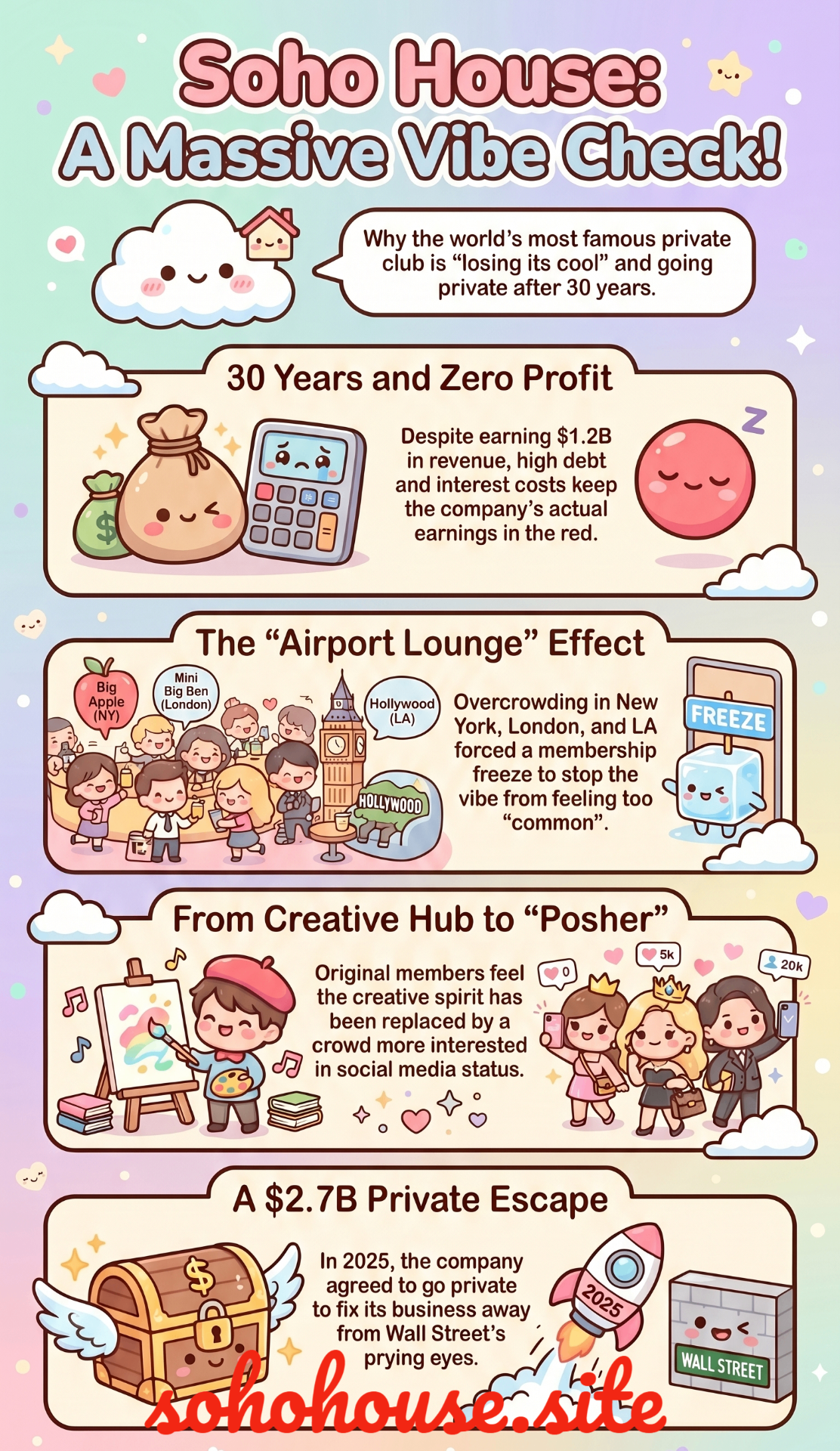
Soho House: A Massive Vibe Check — isometric infographic summarising 30 years of losses, the airport-lounge effect, the creative-to-posh shift, and the $2.7B take-private.
Soho House · A Massive Vibe Check
PDF presentation
Video overview
Audio podcast

Too many members, not enough room

The original promise — a quiet refuge for creatives — has been crushed by its own waitlist. By late 2023 the company froze new memberships in New York, London and Los Angeles after years of overcrowding complaints.

Members describe waits for tables, packed roofs, and rooms that feel less like a private club and more like an airport lounge for people with good outerwear. The freeze was not a flex; it was damage control.

The Independent and Tatler both frame the same trajectory: a club that scaled past the density its physical rooms can hold, then tried to ration access only after the vibe had already left the building.

“The chain of private clubs has become so popular that it's no longer admitting new members.” — CNN Business

The Wall Street war and the WeWork comparison

On 7 February 2024 the short-seller GlassHouse Research published “Soho House & Co: A Company Facing an Existential Crisis,” calling the equity “a zero” and drawing direct lines to WeWork. The stock cratered.

GlassHouse's thesis: nearly 30 years of operating losses, accounting concerns, and a unit-economics story that doesn't survive a sober reread. Bloomberg covered the comparison the same day; the FT's Due Diligence picked it up; The Hollywood Reporter then walked through the full Wall Street war.

Whatever you think of activist shorts, the report forced the company into a defensive posture from which it never really recovered as a public stock.

“Soho House had a crisis of cool that had been years in the making.” — The Hollywood Reporter

The cool problem

“Cool” is a notoriously bad KPI, but multiple outlets have now written the same essay: the people who made the club desirable have drifted, replaced by a crowd that posts.

The Daily Beast wrote the long-form on the social inversion: the rejects-of-traditional-clubs who built Soho House are now themselves the gatekeepers — and the gate has gotten wide. The Independent ran a separate piece on whether enforced “good behaviour” has flattened the rooms into something closer to an All Bar One.

Yahoo Finance/Fortune translated the same story into a balance sheet: $22 cocktails, a CEO under pressure, and a brand whose price-to-aura ratio no longer clears.

“At Soho House, rejects became the new snobs.” — The Daily Beast

Inside the house: labor and culture

If the fish rots from the head, the smell reaches the staff first. Reviews and reporting describe a workplace far from the brand's wellness deck.

Comparably's leadership and culture pages aggregate consistently mediocre internal scores. Breakroom's UK dataset puts Soho House mid-pack among hotels on pay and conditions. Independent first-person accounts on Substack and Medium describe burnout, status games, and a service culture stretched by expansion.

Discrimination and retaliation suits — including a case at Soho Beach House Miami covered by Legal Newsline — round out a picture of a company whose internal experience does not match the lobby.

The exit: $2.7B take-private with Ashton Kutcher on the board

In August 2025 the company agreed to be taken private at $9.00/share — an 83% premium to the unaffected price — by a consortium led by MCR Hotels, with Ron Burkle/Yucaipa rolling their stake and Ashton Kutcher joining the board.

The deal ends Soho House's short, painful career as a public company (NYSE: SHCO) and admits, in the language of capital, what members had been saying for years: the public-markets version of this brand didn't work.

Whether private ownership restores the rooms or simply reprices them is the open question the next chapter will answer.

Second opinions

Ask the machines.

Nine shared conversations with the major AI assistants — same brief, different reasoning. Read them as a chorus, not a verdict.